The Creator's Verdict: Why MAGI-2 vs. MAGI-2-Preview Isn't Even Close for Production
When MAGI-2-Preview landed on Hugging Face in August 2026 under an Apache 2.0 license, it turned heads as a ~114B open-weight proof that single-stream audio-video Mixture-of-Experts scaling works. Three months later, on November 24, 2026, the full 480B MAGI-2 flagship arrived—and changed the conversation from research curiosity to commercial cinema workhorse.
For video creators, agencies, and indie directors, here is the practical bottom line:
- MAGI-2-Preview (~114B / ~6B active) is an open-weight research checkpoint: fixed 10-second takes, 12.5 fps low-res denoising upscaled through
magi2_refiner, 998.5 Elo, basic T2V/I2V only, and a ~274–328+ GiB multi-GPU hardware footprint. - MAGI-2 Flagship (480B / ~28B active) is a production video engine: 4–30 second continuous takes at native 1080p / 25 fps, 1150.3 Elo (+151.8), reference-aware 1080p upscaling, Omni-Reference conditioning (up to 20 multimodal items), and timestamped hard cuts—without touching a single GPU cluster.
Want to judge the motion and native sound yourself before spending a cent? Launch a zero-login browser clip on MAGI-2 Free (up to 3 guest runs/day at 720p with native audio), or keep reading for the full technical and cost breakdown.
Visual Fidelity Deep Dive: magi2_refiner (12.5 fps) vs. Reference-Aware 1080p Upscaling (25 fps)
If you watch a MAGI-2-Preview clip next to a 480B MAGI-2 flagship clip at full screen, the difference jumps off the monitor within two seconds—even before dialogue starts. That visual gap comes from three architectural upgrades working together.
1. Native 25 fps Temporal Fluidity vs. 12.5 fps Base Denoising
MAGI-2-Preview runs its core diffusion pass at 12.5 frames per second across low base resolutions (272p 448×256 or 540p 896×512) and leans on a secondary magi2_refiner model to bring output up to 1080p. When cameras pan across rain, steam, hand gestures, or fast turns, that low base framerate reveals judder and mushy motion blur.
MAGI-2 Flagship doubles native temporal resolution to 25 fps throughout the 4–30 second window, producing natural cinema cadence right out of the generator without third-party frame interpolation.
2. Reference-Aware 1080p Latent Upscaling
Preview's magi2_refiner operates blind to your original upload: it only sees the compressed low-res latent video and guesses missing high-frequency detail. Small background faces, brand packaging, and fine jewelry frequently shimmer or turn unreadable.
Full MAGI-2 pairs its 480B backbone with a reference-aware 1080p latent upscaler that directly re-attends to your source reference images during fine reconstruction. That engineering shift is why MAGI-2's Image-to-Video with Audio score opened near ~1163 Elo—and why product commercials and portrait animations hold likeness cleanly across long takes.
3. 4 Trillion Unfiltered Tokens + Craft-Focused RL Post-Training
Instead of sanitizing training data down to slow stock clips, the 480B flagship scaled pre-training roughly 3× to ~4 trillion tokens (~1 billion samples) while intentionally keeping dense crowds, fast camera pans, legible street text, and complex soundscapes. Because structural anatomy stabilized during pre-training, reinforcement learning (RL) post-training could focus almost purely on visual craft—skin pores, fabric weave, steam turbulence, fur dynamics, and believable lighting falloff.
(Research footnote: On raw 480B pre-trained weights before RL, the model even showed emergent behaviors like visually solving 9×9 Sudoku, planning multi-angle camera coverage autonomously, and translating spoken dialogue across languages. Applying aesthetic RL post-training trades away some of that raw reasoning predictability in exchange for markedly superior commercial cinematography.)
Side-by-Side Spec & Capability Table
| Category | MAGI-2-Preview (Aug 2026) | MAGI-2 Flagship (Nov 24, 2026) | Practical Creator Takeaway |
|---|---|---|---|
| Parameter Scale | ~114B total / ~6B active | 480B total / ~28B active | >4× total params & >4.5× active compute per token |
| Core Architecture | Single-stream Transformer + Multi-Head Latent MoE | Scaled Multi-Head Latent MoE (MagiMoE) | Constant cross-GPU comm; ~22% faster training vs single-head |
| Pre-Training Corpus | 1× baseline | ~4T tokens (~1B samples, ~3×) | Dramatically lower hand/face/crowd artifact rate |
| Video Arena v2.1 (4-Task Avg) | 998.5 Elo | 1150.3 Elo (+151.8) | ~70.6% implied pairwise win rate in blind voting |
| Higgsfield Arena (Nov 24) | Mid-2026 research tier | #2 Overall (1146 BT · 60.5% win) | Beats Seedance 2.0 (71%), Wan 3.0 (79%), Kling 4.0 (83%), MiniMax H3 (83%) |
| Clip Duration | Fixed 10 seconds | Flexible 4–30 seconds | Complete hook + story + payoff in one continuous pass |
| Resolution & Frame Rate | 272p/540p @ 12.5 fps → magi2_refiner | Native 1080p @ 25 fps (ref-aware upscaler) | 2× smoother motion; crisp packaging, logos & small faces |
| Aspect Ratios | Standard preview presets | 6 native ratios (16:9, 21:9, 4:3, 1:1, 3:4, 9:16) | All 6 ratios + adaptive supported in magi2video.im |
| Synchronized Audio | Unified 44.1 kHz stereo (stable-audio-open-1.0) | Synchronized lip-sync dialogue, foley, ambience & score | Tighter voice cadence and distance-accurate acoustics |
| Reference Assets | Basic T2V & single-image I2V | Omni-Reference: up to 20 items natively (10 img + 5 vid on magi2video.im) | Consistent talent, products, locations & camera choreography |
| Directorial Timeline | Single shot only | Timestamped hard cuts (up to 15 cuts in 30s) + video editing | Direct multi-shot commercials in a single generation |
| Open-Source Status | Apache 2.0 (sand-ai/MAGI-2-preview on HF) | Cloud & API live; open weights announced | Preview open now; 480B weights pending |
| Infrastructure / Price | ~274–328+ GiB disk; 8× Hopper ref / 96 GB NVFP4 | $0.08/s raw API · zero-login 720p free guest runs on magi2video.im | ~84% cheaper at 1080p than Seedance 2.5 |
Benchmarks in Context: +151.8 Elo & Leaderboard Reality
In the independent Nov 24, 2026 Higgsfield Video Arena blind director ranking, the 480B flagship placed #2 overall (1146 Bradley-Terry, 60.5% overall win rate)—trailing only closed-weight Seedance 2.5 (1219) while beating Seedance 2.0 (71%), Wan 3.0 (79%), Kling 4.0 (83%), and MiniMax H3 (83%). See our dedicated MAGI-2 vs Seedance 2.5 breakdown.
Directing 30-Second Multi-Cut Commercials (Impossible on Preview)
Because MAGI-2-Preview locks you into a single 10-second shot with no Omni-Reference assets, producing a 30-second commercial requires generating multiple disconnected clips and hiding identity drift in editing.
On MAGI-2 Flagship, you can script second-level hard cuts—demonstrated up to 15 shots in 30 seconds—while preserving lighting, set dressing, and actor continuity. Try this 30-second culinary commercial prompt in our AI Video Generator (or grab more tested templates from MAGI-2 Prompts and Live Prompt Clips):
30 seconds, 16:9, cinematic 35mm food documentary lighting, rainy Tokyo back-alley ramen counter at midnight.
0–10s: Low-angle dolly-in from the rain-drenched street through billowing warm steam and red lantern glow toward a wooden counter; raindrops pattering on vinyl awning and distant muffled city traffic.
10–20s: Hard cut to a crisp close-up inside the kitchen as the chef lifts glossy handmade noodles from boiling broth with long wooden chopsticks and lays charred chashu slices into a black ceramic bowl; loud broth simmer, ceramic clink, and crisp ladle pour.
20–30s: Hard cut to a warm medium shot across the counter as the chef slides the steaming bowl forward, smiles slightly, and says naturally in Japanese: "Omatase shimashita—please enjoy while it's hot." Accurate lip-sync, soft bokeh lantern reflections, gentle acoustic shamisen note fading in.
Total Cost of Ownership: Self-Hosting Preview vs. magi2video.im
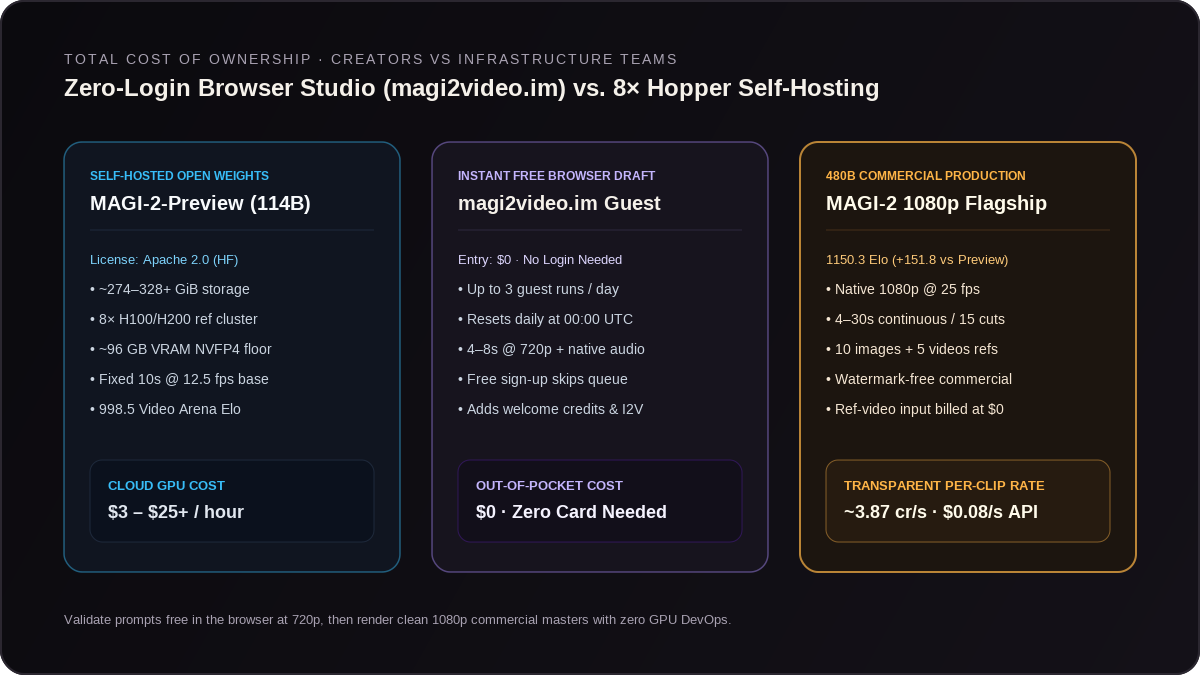
"Open source" does not mean "free to run." Before downloading sand-ai/MAGI-2-preview, compare the actual hardware bill against running the superior 480B flagship in the cloud.
Real Self-Hosting Requirements for MAGI-2-preview
- Storage: ~274–328+ GiB on fast NVMe (~228 GB transformer + ~56 GB
Qwen/Qwen3.5-27Btext encoder + video VAE,magi2_refiner, andstable-audio-open-1.0audio module). - Official compute target: 8× NVIDIA Hopper (H100/H200) or 4-GPU sequence-parallel (SP4) nodes with containerized inference or community vLLM-Omni stacks.
- Single-GPU quantized floor: Heavily quantized community NVFP4 recipes still need roughly 96 GB VRAM (e.g., NVIDIA RTX PRO 6000 Blackwell)—far beyond consumer 16–24 GB cards.
Practical Access & Cost Comparison (November 2026)
| Access Path | Model & Quality | Duration & Resolution | Billing & Setup | Best For |
|---|---|---|---|---|
| magi2video.im Guest Trial | Browser studio preview | 4–8s · 720p + native audio | $0 · No login, no card (up to 3/day, resets 00:00 UTC) | Instant prompt, pacing & audio validation |
| magi2video.im Free Account | Instant-submit studio | 720p + I2V & 9:16/1:1 | $0 · Welcome credits (skips 3.5-min guest queue) | Fast drafting & Image-to-Video tests |
| magi2video.im Paid 1080p | MAGI-2 480B Flagship (1150.3 Elo) | 4–30s · Native 1080p @ 25 fps · 10 img + 5 vid refs | ~3.87 credits/s (0 ref-video fee); yearly from $14.95/mo, packs from $19.90 | Watermark-free commercial MP4s & multi-shot ads |
| Raw Official MAGI-2 API | MAGI-2 480B Flagship (1150.3 Elo) | 4–30s · Native 1080p @ 25 fps | $0.08/s ($0.40 / 5s · $0.80 / 10s · $2.40 / 30s) | Automated engineering batch pipelines |
Self-Hosted MAGI-2-preview | 114B Preview (998.5 Elo, Apache 2.0) | Fixed 10s · 12.5 fps base → refiner | $3–$25+/hr cloud GPU rental (8× Hopper / 96 GB NVFP4) + 330 GB disk | MoE research, LoRA fine-tuning, air-gapped on-prem |
Quick Decision Guide & Honest Limitations
- You want watermark-free 1080p / 25 fps deliverables for ads, YouTube, TikTok, or client work.
- You need 15–30 second scenes, timed multi-shot cuts, or Omni-Reference asset consistency.
- You want to validate prompts for $0 without logging in before rendering 1080p masters.
- You require Apache 2.0 downloadable weights today for custom fine-tuning, distillation, or quantization.
- Enterprise security mandates strictly air-gapped on-premise inference.
- You already run 4×–8× Hopper GPUs or a 96 GB Blackwell workstation.
Four Limitations Worth Planning Around (Even on 480B)
- Extreme high-speed motion: Whip pans, dense melee strikes, and rapid flying debris can still introduce occasional limb distortion—keep fast shots anchored to one clear subject.
- Medium and wide 2D anime shots: Close-ups look crisp, while medium and wide hand-drawn animation can appear slightly over-smoothed.
- Dense multi-layered audio mixes: Spoken dialogue and core foley sync reliably, though busy stadium crowds layered over complex orchestral scores still benefit from light audio mastering in post.
- 480B open weights are not live yet: Teams requiring local flagship weights must wait for the follow-up open-weight drop (which will demand multi-node enterprise compute).
Frequently Asked Questions
Why does full MAGI-2 look so much sharper than MAGI-2-Preview at 1080p?
Preview denoises at 272p/540p @ 12.5 fps and relies on a separate magi2_refiner that never sees your reference image. Full MAGI-2 renders native 25 fps motion with a reference-aware 1080p latent upscaler that directly re-reads uploaded reference stills during detail reconstruction.
How large is the real quality gap between MAGI-2 and MAGI-2-Preview?
On Artificial Analysis Video Arena v2.1 (4-task average), MAGI-2 jumped from 998.5 Elo (Preview) to 1150.3 Elo (Flagship)—a +151.8 Elo gain representing roughly a 70.6% head-to-head human preference win rate.
What creative tools exist in full MAGI-2 that are missing in MAGI-2-Preview?
Continuous 4–30s takes, 6 native aspect ratios, Omni-Reference conditioning (up to 20 multimodal items natively; 10 images + 5 videos on magi2video.im), timestamped multi-shot hard cuts (up to 15 in 30s), and targeted video editing.
Can solo creators run MAGI-2-Preview for free on a home GPU?
Not practically on 16–24 GB consumer cards. sand-ai/MAGI-2-preview takes ~274–328+ GiB on disk (~228 GB transformer + ~56 GB Qwen3.5-27B). Official inference targets 8× Hopper or 4-GPU SP4 servers, and NVFP4 community quantization still requires roughly 96 GB VRAM (e.g., RTX PRO 6000 Blackwell).
How can I test MAGI-2 online for free before paying or renting GPUs?
Visit MAGI-2 Free on magi2video.im to run 4–8 second 720p videos with native audio directly in your browser with no login and no credit card (up to 3 guest runs/day, resetting at 00:00 UTC), or sign in free to skip the queue and claim welcome credits.
Why is 480B MAGI-2 still affordable per second in cloud studios and APIs?
Its sparse Multi-Head Latent MoE architecture activates only ~28B of 480B parameters (~5.8%) per token, keeping raw API compute at $0.08/second and making 1080p production roughly 84% cheaper than Seedance 2.5.
Is the 480B MAGI-2 flagship open source under Apache 2.0?
MAGI-2-preview (114B) is Apache 2.0 on Hugging Face today. Open weights and technical documentation for the 480B flagship have been announced to follow its initial hosted and API launch.
When should a team still choose MAGI-2-Preview over full MAGI-2?
Only when Apache 2.0 downloadable weights today are strictly required—such as academic MoE research, custom LoRA fine-tuning, vLLM-Omni benchmarking, or air-gapped enterprise clusters.
Start Creating with MAGI-2 Today
- Try MAGI-2 Free Online (No Login) — Test 4–8s 720p clips with native audio straight in your browser (up to 3 runs/day).
- Open the MAGI-2 1080p Studio — Render 4–30s native 1080p/25fps scenes across all 6 aspect ratios with 10 images + 5 video references.
- MAGI-2 Examples Showcase — Watch real combat, VFX, vertical drama, and anime clips with director notes.
- MAGI-2 Prompt Templates & Tested Clips — Copy 3-layer shot sheets and watch verbatim prompt outputs.
- MAGI-2 vs Seedance 2.5 & Pricing Plans — Compare 1080p cost math, 2× first-month monthly tiers, 50%-off annual plans, and $19.90 no-expiry packs.